What Is Water Treatment Flocculant and How Does It Work?

Time:2026-10-18 Author:Amelia
0%

Clean water often begins with particles that are too small to see. Clay, organic matter, algae, and microorganisms may remain suspended, making water cloudy and difficult to clarify. Water Treatment Flocculant helps solve this problem by encouraging these tiny particles to form larger, heavier clusters called flocs.

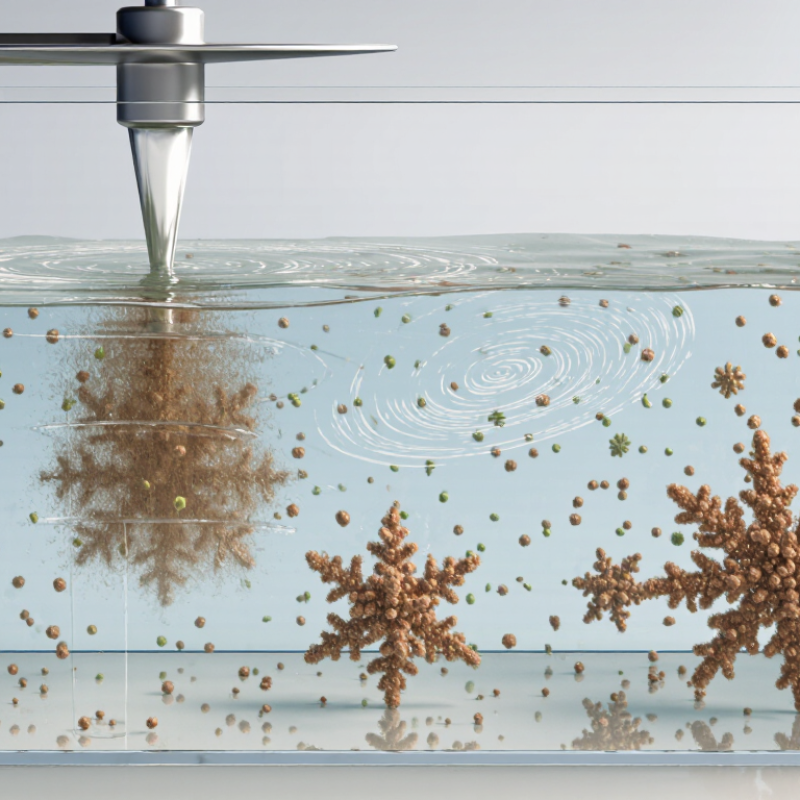
Water-treatment authority Dr. James K. Edzwald has emphasized: “Coagulation and flocculation are essential processes in water treatment.” This principle appears simple, but practical performance depends on chemistry, mixing, temperature, and dosage. A treatment operator may add the flocculant into a rapid-mixing tank, where the chemical spreads through the water. Gentle mixing follows. The growing flocs resemble soft, brown snowflakes moving slowly through the tank.

The process is not magic.

A flocculant does not remove every contaminant by itself. It supports separation. The formed flocs can settle in a clarifier or become trapped during filtration. Correct dosing matters greatly. Too little chemical may leave water visibly cloudy. Too much can create fragile flocs, increase residual chemicals, or complicate filtration.

Real systems also behave differently from laboratory tests. Water quality changes after heavy rain, industrial discharge, or seasonal algae growth. For this reason, reliable operators use jar testing, routine monitoring, and documented adjustments. Some explanations oversimplify flocculation as merely “clumping.” That description is useful, but incomplete. Particle charge, polymer bridging, shear force, and settling time also influence results.

This guide explains what Water Treatment Flocculant is, how it works, and where careful judgment remains necessary.
What Is Water Treatment Flocculant and How Does It Work?

What Is Water-Treatment Flocculant? Types, Chemistry, and Active Polymers

Water-treatment flocculant is a chemical aid that gathers tiny suspended particles into larger, settleable clusters. It works after coagulation, when rapid mixing has weakened particle charges. Gentle mixing then encourages particles to collide and form visible flocs. The water may look clearer within minutes. However, appearance alone cannot prove complete treatment.

Flocculants include inorganic materials, natural polymers, and synthetic polymers. Active synthetic polymers are often classified as cationic, anionic, or nonionic. Cationic polymers attract negatively charged particles, including many organic solids. Anionic polymers often perform well with positively charged mineral particles. Nonionic polymers rely more on adsorption and physical bridging. Their long molecular chains connect several particles, forming stronger networks. Molecular weight, charge density, and chain structure control this performance. Small chemical differences matter.

Operators usually prepare a dilute solution before controlled dosing. Excessive concentration can create slimy, fragile flocs and increase residual polymer. Too little dosage leaves the water visibly cloudy. Jar testing remains essential, because raw-water chemistry changes with rainfall, temperature, and industrial activity. A clear jar test can still mislead if mixing conditions differ from the full-scale system. The process is not perfectly predictable. Experienced technicians watch floc size, settling speed, and filter pressure together, then adjust gradually.

How Water-Treatment Flocculants Improve Particle Settling

Flocculants help destabilized particles join into larger flocs. Under ideal Stokes-law conditions, settling velocity increases approximately with the square of particle diameter. The values below are relative to a 10 µm floc and assume the same density difference, water viscosity, and spherical particle shape.

How Charge Neutralization and Polymer Bridging Build Settleable Flocs

Water treatment flocculant helps turn tiny suspended particles into larger, settleable flocs. Many particles carry similar negative charges, so they repel each other like two magnets facing the same pole. Charge neutralization reduces this repulsion. Coagulant chemicals or charged polymers gather around particle surfaces and compress their electrical barrier. The particles can then approach one another.

The process starts with rapid mixing. A treatment operator must disperse the chemical quickly without creating excessive turbulence. Slow mixing follows. Long polymer chains reach between destabilized particles and form bridges. This polymer bridging creates soft, irregular clusters that can grow during gentle agitation. Some flocs look like pale snowflakes under a jar-test lamp.

Dose control matters greatly. Too little chemical leaves particles stable. Too much can restabilize them or produce slippery, fragile flocs. pH, alkalinity, temperature, and organic matter also change performance. A polymer that works well in one raw-water sample may perform poorly after heavy rainfall. That is why experienced operators compare several doses through jar testing, checking settling speed, water clarity, and floc strength. The process is less tidy than diagrams suggest. Even a good test can miss full-scale problems, such as uneven chemical distribution or excessive shear in a pipe. Settled flocs may break apart before clarification if pumping conditions are too harsh. Small operational details often decide whether charge neutralization and polymer bridging produce clear water or a cloudy result.

How Jar Tests Set Dosage, Mixing, and pH: Typical Doses of 0.1–100 mg/L

What Is Water Treatment Flocculant and How Does It Work?

A water treatment flocculant helps small suspended particles join into larger, heavier flocs. These particles may include clay, organic matter, pigments, or metal hydroxides. The chemical does not remove pollution by itself. It improves separation during sedimentation or filtration.

Jar tests set the working conditions. Fill six clear beakers with the same sample, then add different flocculant doses. A practical screening range is 0.1–100 mg/L, although the correct value depends on turbidity, solids, temperature, and water chemistry. Prepare a diluted stock solution for accurate low-dose testing. Tiny dosing errors matter.

Mixing matters greatly. A rapid blend may last 30–90 seconds, followed by gentle mixing for 5–20 minutes. Watch the flocs. They should grow without breaking apart. Allow 15–30 minutes of settling, then compare supernatant clarity, sludge volume, and filtration behavior. Not a fixed recipe.

pH can change performance sharply. Test several pH points around the plant’s normal operating range, because charge neutralization and polymer behavior depend on chemistry. A dose that performs at pH 7 may fail at pH 5. Record every condition, including water temperature and mixing speed. Operators sometimes choose the clearest beaker, but that can be misleading if the floc settles slowly or produces excessive sludge. The best result balances clarity, settling time, residual chemical, and operating cost. Recheck the test when seasons or source-water quality change.

How Flocculation Reduces Turbidity Toward the EPA Target of 0.3 NTU

What Is Water Treatment Flocculant and How Does It Work?

A water treatment flocculant helps tiny suspended particles join into larger, heavier clusters. These clusters are called flocs. Coagulants first neutralize particle charges. Gentle mixing then allows flocculants to bridge the particles. The growing flocs settle more easily before filtration.

This step directly supports lower turbidity. The U.S. EPA’s Long Term 2 Enhanced Surface Water Treatment Rule targets 0.3 NTU or less in at least 95% of monthly combined filter effluent measurements. It also sets a 1 NTU maximum for individual measurements. Turbidity matters because particles can shield microorganisms from disinfectants. The World Health Organization therefore recommends keeping treated water below 1 NTU whenever possible.

Operators usually confirm performance through jar testing. They adjust pH, mixing speed, contact time, and chemical dose. A correct dose creates firm, visible flocs without excessive chemical carryover.

Overdosing can produce fragile particles and increase filter loading. Underdosing leaves water cloudy.

The target is not always stable. Rainfall, algae, temperature, and raw-water chemistry can change it within hours. A clear jar test can still mislead if field mixing differs.

Tips:

Measure turbidity after each treatment stage, not only at the outlet. Record raw-water temperature and pH beside every test. EPA data supports the 0.3 NTU benchmark, but local validation remains essential. Operators should question unusually perfect results and repeat the test when conditions shift.

How Dewatering Performance Is Measured by CST, SRF, and Cake Solids (%)

Water treatment flocculant gathers fine suspended particles into larger, heavier flocs. This change makes sludge easier to separate from water. In practice, dewatering performance is not judged by appearance alone. A clear filtrate can still produce a wet, difficult-to-handle cake.

Capillary Suction Time, or CST, measures how quickly water moves through a filter paper under capillary force. Lower CST values usually indicate faster drainage. For a practical check, an operator can test a mixed sludge sample before and after flocculant dosing. The sample should be mixed consistently, because excessive shear can break the flocs. Small testing errors matter.

Specific Resistance to Filtration, or SRF, describes the resistance created by the sludge cake during filtration. Lower SRF generally means easier water release. SRF is useful for comparing doses, but it depends on pressure, solids concentration, and test conditions. It should not be treated as a universal number.

Cake solids percentage shows how much dry material remains after dewatering. For example, a 20% cake contains roughly 20 kilograms of dry solids in 100 kilograms of wet cake. Higher cake solids can reduce transport volume, yet a dense cake may not always filter quickly. The results can conflict. That is normal. A reliable evaluation records CST, SRF, cake solids, polymer dose, mixing energy, and test time together.

FAQS

What is a water-treatment flocculant?

It gathers tiny suspended particles into larger clusters called flocs. These clusters settle more easily before filtration. Gentle mixing helps. Appearance alone proves little.

How does flocculation reduce turbidity?

Coagulation weakens particle charges first. Flocculant chains then connect particles, creating heavier structures that reduce cloudiness. Operators may target 0.3 NTU or below in combined filtered water. Local testing remains necessary.

What types of flocculants are commonly used?

Common types include inorganic materials, natural polymers, and synthetic polymers. Synthetic polymers may be cationic, anionic, or nonionic. Cationic polymers attract negative particles. Anionic polymers often suit positive mineral particles.

Why do molecular weight and charge density matter?

Long molecular chains can bridge several particles. Charge density affects attraction and floc strength. Small chemistry changes matter. More charge is not always better.

How is the correct flocculant dosage selected?

Operators prepare a dilute solution and compare doses through jar testing. They adjust pH, mixing speed, contact time, and dosage. Too little leaves cloudy water. Too much may create slimy, fragile flocs.

What should operators observe during a jar test?

Watch floc size, settling speed, water clarity, and filter pressure. Record temperature and pH beside every test. A clear jar can mislead. Full-scale mixing may differ.

How are CST, SRF, and cake solids used?

CST estimates drainage speed, while lower values often indicate faster water release. SRF describes resistance during filtration. Cake solids show dry material percentage. A 20% cake contains about 20 kilograms of dry solids per 100 kilograms of wet cake.

Can one test prove dewatering performance?

No. Record CST, SRF, cake solids, polymer dose, mixing energy, and test time together. Results may conflict. A clear filtrate can still leave a wet cake. Repeat tests when conditions shift.

Conclusion

Water Treatment Flocculant is a chemical aid used to gather fine suspended particles into larger, stronger clusters called flocs. These products may be inorganic coagulants, organic polymers, or blended formulations, with their performance determined by charge density, molecular structure, and water chemistry. Through charge neutralization, the flocculant reduces the repulsive forces that keep particles apart. Polymer chains can then attach to multiple particles at once, creating bridges that form settleable flocs.

Effective treatment depends on controlled testing rather than a fixed formula. Jar tests help determine the appropriate dosage, mixing intensity, contact time, and pH, with common dosages ranging from 0.1 to 100 mg/L. Proper flocculation can significantly lower turbidity and support treatment goals approaching an EPA target of 0.3 NTU. For sludge handling, performance is evaluated using measurements such as capillary suction time (CST), specific resistance to filtration (SRF), and cake solids percentage. These indicators show how easily sludge releases water and how efficiently it can be dewatered.


Amelia

Amelia

Amelia is a seasoned marketing professional with a wealth of expertise in our company’s core offerings. With an unwavering passion for driving growth and innovation, she plays a pivotal role in shaping our marketing strategies and enhancing brand visibility. A key aspect of her responsibilities......